
We are New Zealand's Only Turtle Specialists!
(TRADE SUPPLY ONLY)
P.O. Box 7057, Taradale, Napier 4141, New Zealand
|
We are New Zealand's Only Turtle Specialists! (TRADE SUPPLY ONLY) P.O. Box 7057, Taradale, Napier 4141, New Zealand |
EASTERN WATER DRAGONPHYSIGNATHUS LESUEURII LESUEURII
The Eastern Water Dragon (Physignathus lesueurii lesueurii) is from Eastern Coast of Australia. They are tolerant of humidity and cooler temperatures. The Eastern Water Dragon is hardy, not much of a fussy eater, and loves bathing in water. They must be provided a good sized water pool or pond that they can completely submerge themselves in. They also defecate in the water and very little out of the water. Therefore the water must be changed regularly.
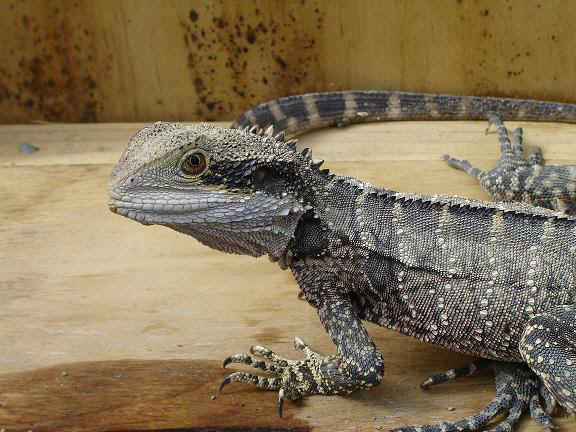
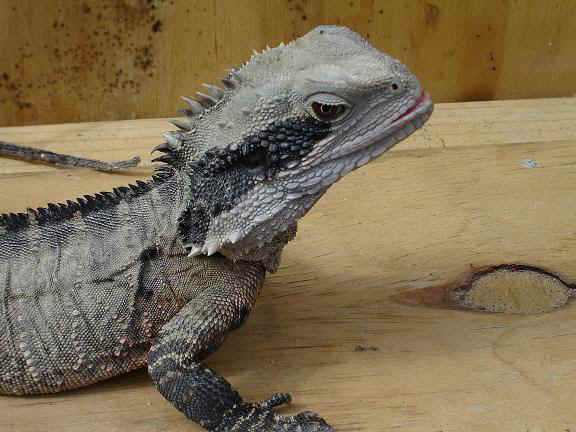
(The above pics show the obvious male / female difference in appearance. The top picture being the Female, and the lower being the Male. These are both five years of age.) Eastern Water Dragons are a pet for anyone who wants something different and large!! Males are said to reach 1 metre in length, and females up to 80cm in length. They can live in captivity for approx. 25 years if they aren't forced in growth during their first two years. If they are forced then their life expectancy is halved. 70% of their length is tail, which is slightly flattened vertically and is used as a paddle when swimming. Their tails are very strong and don't fall off if grabbed like a Gecko or Skink. However, it is not recommended to grab their tails as this can cause irreparable damage to the tail or their spine. Like Turtles, the Eastern Water Dragon requires correct lighting, diet and specialised housing in order for them to thrive. Housing Hatchling Water Dragons can be done easily in an empty glass fish tank. We have raised two hatchlings in a tank 120 x 40 x 40cm. If I was to raise up to four hatchlings then I would recommend using a tank 150 x 50 x 50cm. A large water tray, bark on the floor, a flat rock under a heat lamp, and a UVB Reptile light above was pretty much the tank set up. It is worth mentioning here that the UVB Reptile light must be no more than 300mm away from the Dragons basking spot as the effectiveness of the light is greatly reduced the further away it is. See Reptile Lighting page for the correct lighting for your Reptile. We found that the tank was a perfect sized home until they were about 15 months of age. When they got to this age they were growing quite fast and were continuously trying to climb the walls to escape. This is when we moved them to their outside enclosure. The outside enclosure is much like a small bird aviary. The strong 1/4 inch mesh is great for them to be able to climb to the best sunning position. Plenty of logs and plants for them to climb also make the enclosure look more natural.
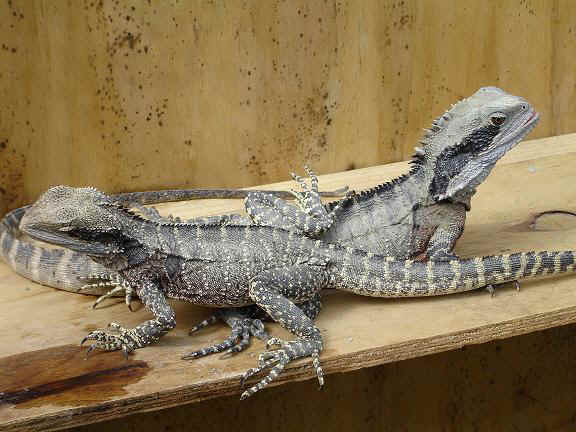
(The same pair as above basking together in the sun.) |
| Hot House Turtles Limited © 2022 |